
Why is it so critical that military equipment is robust, reliable, and compatible? It all comes down to UK Defence Standards (DEF STAN), the essential engineering and technical qualifications established by the UK Ministry of Defence (MOD) to ensure British Armed Forces’ technology is truly interoperable, dependable, and safe.
In this Q&A, GRiD Defence Systems – a British SME with a long history of supplying to the UK MoD – exemplifies this commitment. For example, the newly released GRiDCASE 1517 17” Rugged Laptop is being qualified to DEF STAN Land Class B as verified by a UKAS (United Kingdom Accreditation Service) accredited test house.
What makes GRiD particularly unique is its position as an onshore British manufacturer of its products that meet demanding standards, specifically for the MOD. These include DEF STAN 00-035, which tests environmental conditions for defence technologies, and DEF STAN 59-411, a stringent Electromagnetic Compatibility (EMC) standard.
Let’s dive into some of the most common questions about these vital standards and GRiD’s innovative work in support of meeting DEF STANs.
Read more about the GRiDCASE 1517 17” Rugged Laptop here.
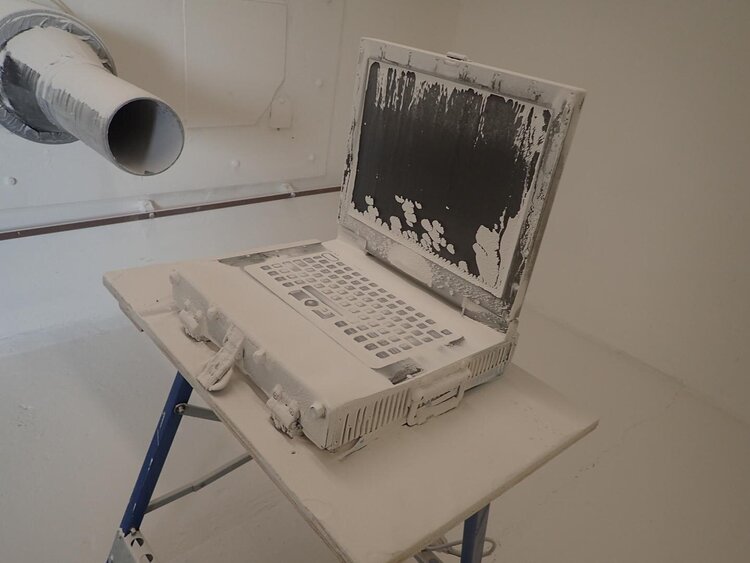
GRiDCASE 1590 during sand and dust testing
Q. How does GRiD ensure its products meet DEF STAN 59-411 and other testing standards?
GRiD Answer: Our products are specifically designed and manufactured from the ground up, for demanding tactical environments, and their EMC performance has been rigorously qualified to both UK (DEF STAN 59-411) and US (MIL-STD 461) standards. This ensures GRiD’s technologies meet the most stringent requirements for electromagnetic emissions and susceptibility in critical operational settings.
Every GRiD rugged laptop, tablet, or processor incorporates custom electronics and advanced filtering to maintain exceptionally low EMC profiles. The entire portfolio is constructed from a solid aluminium tool plate, which serves to effectively block electromagnetic fields.
Additionally, all associated cabling is designed and built by GRiD to prevent electromagnetic noise. GRiD’s rugged display panels further enhance EMC performance by featuring an EMC window that mitigates both radiated emissions and susceptibility.
Q. How does an operational environment influence DEF STAN?
GRiD Answer: The EMC standards governing a rugged laptop or tablet are not universal; they are critically determined by its intended operational environment. This means an EMC standard suitable for a device inside a tank (Land) will differ significantly from one used on an aircraft (Air) or a frigate (Sea). Each domain is broken down further into subcategories to meet the EMC challenges within various environments.
In relation to air, these are highly specific, with requirements varying significantly based on the type of aircraft (e.g., helicopter, fighter jet, transport plane). This accounts for differences in platform-generated interference, system density, and critical safety considerations.
For maritime applications, the standards differentiate based on a system’s physical placement within the vessel; whether it will be used above decks (exposed to external radar, communications, and weather elements) or below decks (within the more shielded, but potentially more crowded, internal environment of the ship).
For Land, it is broken down from Land Class D through to Land Class A. Land Class D applies to electronic systems that can operate normally and reliably when positioned more than 100m from an antenna. This often encompasses larger, more stationary installations. Land Class C dictates that equipment must maintain operational integrity when situated between 15m and 100m from an antenna. This covers a broad spectrum of vehicle-mounted and deployable systems.
Systems falling under Land Class B are designed to operate effectively in closer proximity, specifically between 2m and 15m from an antenna. Finally, Land Class A is the most stringent land standard, specifically covering personnel-worn systems that must be fully functional and robust even when operating within 2m of an antenna.
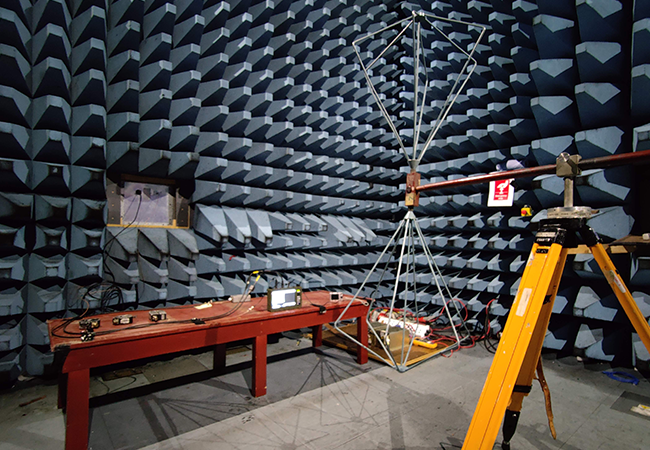
GRiDCASE 2530 during Def Stan EMC testing
Q. What’s the process for qualifying a product to a DEF STAN, if a customer was seeking to qualify a rugged laptop to meet a certain standard?
GRiD Answer: It starts when the MOD specifies a new military hardware capability which must adhere to a particular standard, like DEF STAN 59-411 Land Class A.
A prime contractor issues a technical specification to a subcontractor, such as GRiD, outlining the computer requirements and the need to meet the specified standards.
At GRiD, we would assess our range of rugged laptops and tablets to find the most suitable solution that meets the customer requirements, including the Defence Standard(s) they need to meet. Once selected, the product is sent to a UKAS accredited test house for qualification.
The test house develops a comprehensive test plan, which GRiD approves typically in consultation with the prime contractor. Testing then commences, with durations varying from one day to several weeks. This can include environmental testing for factors like temperature, humidity, and salt fog, or specific tests like drop tests or solar radiation testing. The prime contractor will only require specific tests within the standard.
A detailed report is generated, indicating a summary of the passes along with detailed results, which serves as official evidence that the rugged laptop meets the required standard.
Q. How does GRiD seek success with DEF STAN requirements?
GRiD: Firstly, as a UK-based company, GRiD has an extensive history of expertise in MOD programmes. This provides prime contractors with the assurance that GRiD possesses a thorough understanding of the UK defence landscape and knowledge of operational requirements.
Additionally, for formal testing, GRiD utilises UKAS third-party test houses, ensuring objective and impartial results. And recently, GRiD has also invested in its in-house testing capabilities, enabling increased oversight of the process and facilitating more in-depth and routine testing of devices, which ultimately benefits the customer.
Finally, as an SME comprised of highly skilled engineers, GRiD has in-depth command of our products, enabling us to effectively diagnose failures and implement improvements or enhancements to the technology, as required.
The GRiD approach
GRiD exclusively employs UKAS-accredited independent test houses to carry out testing, which ensures that qualification is carried out thoroughly, impartially and the standard is fully followed.
All aspects of certification is critical to GRiD and its family of rugged laptops and tablets. Only by independently certifying to the highest of standards and leveraging the expertise of UK engineers can GRiD ensure that it delivers best-in-class performance to its customers – British made products to a UK military-grade defence standard.
If you want to learn more on GRiD’s product range, please see here or if you would like to discuss how GRiD can support your DEF STAN journey in more detail, please get in touch on +44 (0)1628 810 230 or drop an email to sales@griduk.com.